



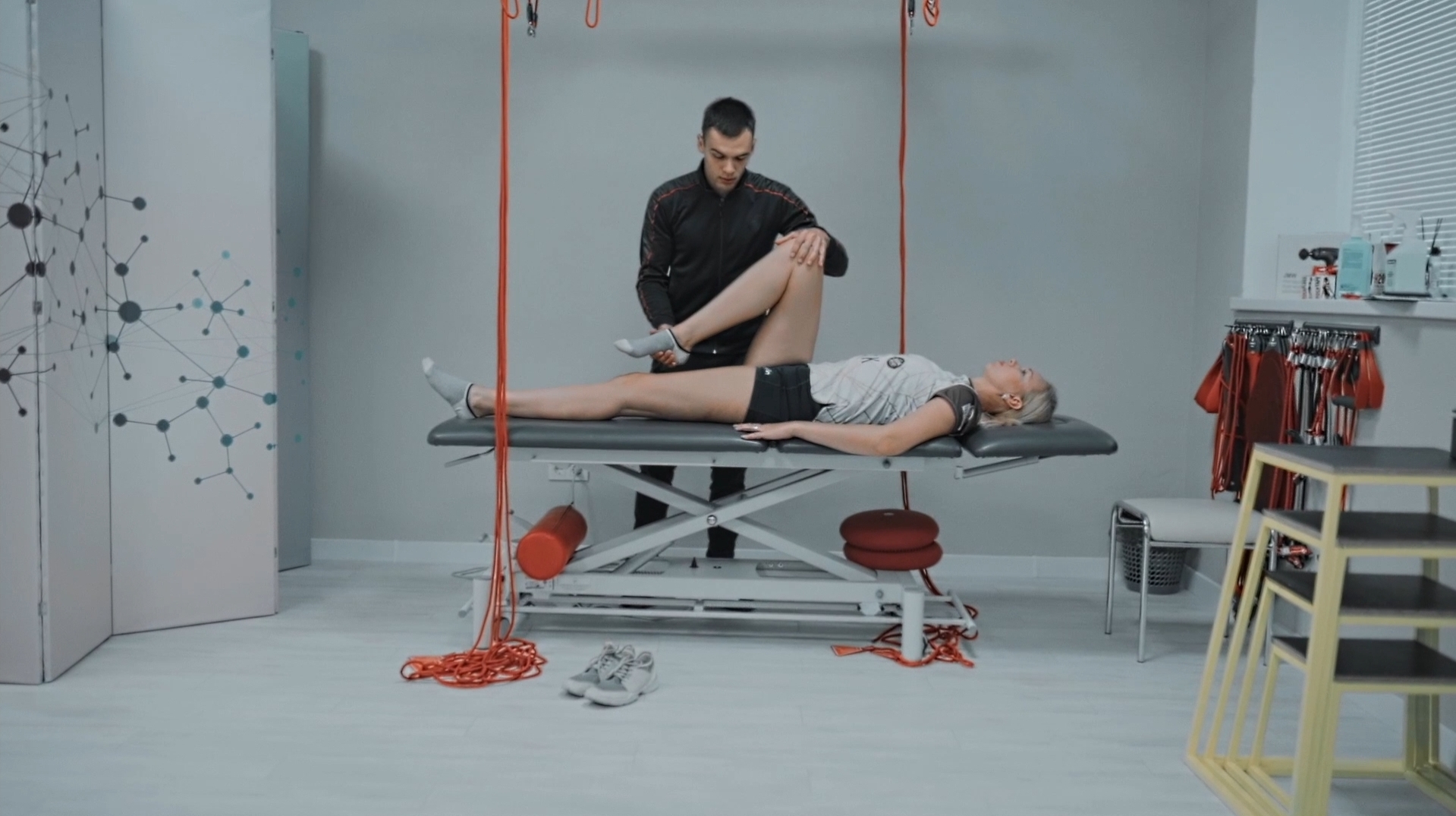
An anterior cruciate ligament (ACL) tear divides life into “before” and “after.” Pain, swelling, and a feeling of instability in the knee often make people believe they will have to give up sports and physical activity. However, this is a myth: returning to the activities you enjoy is entirely achievable when rehabilitation is approached as a structured and carefully monitored process.
Successful rehabilitation after an anterior cruciate ligament (ACL) tear depends on appropriately prescribed exercises, gradual progression, and patience. Whether you are a professional athlete, a service member, or simply want to return to an active, pain-free lifestyle, high-quality physical therapy will be your most valuable tool.
Why Does an ACL Injury Require a Phased Rehabilitation Process?
The Physiology of Healing and the Role of Physical Therapy
The anterior cruciate ligament (ACL) is responsible for stabilizing the knee joint by preventing excessive forward movement of the tibia relative to the femur. Following ACL reconstruction or conservative treatment, the graft requires time to integrate and become revascularized through a process known as ligamentization. Physical therapy for the knee joint restores neuromuscular control while helping prevent quadriceps muscle atrophy.
The Risks of Returning to Activity Too Early
Returning to running or contact sports too soon is one of the leading causes of re-injury. According to clinical research (including publications in the British Journal of Sports Medicine), returning to sport before nine months after surgery significantly increases the risk of a second ACL rupture.
Key Stages of Rehabilitation After an ACL Tear
The rehabilitation process can be divided into four key phases, each with specific goals:
- Phase 1: Early Postoperative Period (0–4 weeks). The primary goals are to control pain and swelling, restore full knee extension, and activate the quadriceps muscle.
- Phase 2: Strength and Neuromuscular Control (4–12 weeks). This phase focuses on restoring a normal walking pattern, strengthening the thigh and gluteal muscles, and improving proprioception (balance and joint position awareness).
- Phase 3: Functional Physical Conditioning (3–6 months). Exercises following a knee injury are introduced to restore straight-line running, develop plyometric capacity, and improve muscular strength and endurance.
- Phase 4: Return to Sport and High-Level Activity (6+ months). Training includes cutting, pivoting, jumping, and sport- or occupation-specific drills tailored to the individual’s goals.
Rehabilitation Phases and Progression Criteria
The table below summarizes the key phases of rehabilitation following ACL reconstruction:
| Phase | Approximate Timeline | Primary Goals | Recommended Exercises and Activities | Criteria for Progression |
| I. Acute Phase | 0–4 weeks | Reduce pain and swelling, achieve full knee extension (0°) | Quadriceps isometrics, straight-leg raises, patellar mobilization | Full extension, knee flexion greater than 90°, minimal or no swelling |
| II. Strength Phase | 4–12 weeks | Restore normal gait and increase muscle strength | Squats, lunges, glute bridges, balance training on unstable surfaces | Quadriceps strength greater than 70% of the uninvolved leg and symmetrical gait |
| III. Functional Phase | 3–6 months | Initiate running and prepare the knee for impact loading | Treadmill running, low-level plyometrics, stationary cycling | Muscle strength greater than 85%, pain-free running |
| IV. Return-to-Sport Phase | 6–12 months | Return to sport after rehabilitation | Cutting drills, pivoting, rotational movements, contact-specific training | Successful completion of a functional test battery (LSI > 90%) |
Key Exercises and Rehabilitation Techniques for the Knee Joint
Exercises to Restore Range of Motion and Neuromuscular Control
During the first few weeks, rehabilitation focuses on passive and active knee extension. For example, isometric quadriceps contractions performed in a supine position help “reactivate” the muscle, which commonly becomes inhibited following surgery.
Strength Training and Balance Exercises
As swelling subsides, closed kinetic chain exercises are gradually introduced, including bodyweight squats, Romanian deadlifts, and balance training on unstable surfaces. These exercises help retrain the knee joint and the nervous system to function together as an integrated unit.
Plyometric Training and Sport-Specific Functional Testing
During the later stages of rehabilitation, double-leg and single-leg hop tests are incorporated into training. These exercises help determine whether the knee is prepared for dynamic loading, landing, and deceleration.
How to Prevent an ACL Re-Tear: Return-to-Sport Criteria and Injury Prevention
Following objective return-to-sport criteria significantly reduces the risk of re-injury. Preventing a recurrent ACL injury requires objective assessment rather than relying solely on the amount of time that has passed since surgery.
Checklist: Safe Return-to-Sport Criteria
- No pain or swelling following functional activities.
- Full, symmetrical knee extension and flexion.
- Strength of the involved leg is at least 90% of the uninvolved leg, as measured by isokinetic testing or dynamometry.
- Successful completion of hop tests with a Limb Symmetry Index (LSI) greater than 90%.
- Psychological readiness to return to sport, including confidence in the knee and absence of fear of re-injury.
Frequently Asked Questions
1. How Long Does Full Rehabilitation After an ACL Tear Take?
Complete rehabilitation typically takes between 8 and 12 months. While most individuals can return to daily activities much sooner, returning to contact sports requires sufficient time for complete graft ligamentization and restoration of functional performance.
2. Can an ACL Tear Be Treated Without Surgery?
Yes. Conservative management may be an appropriate option for individuals with low physical demands or for those who do not experience episodes of knee instability during everyday activities. The decision should be made collaboratively with an orthopedic surgeon and a physical therapist based on the patient’s goals, activity level, and clinical findings.
3. When Can I Start Running Again?
Light straight-line running is typically introduced no earlier than 3 to 4 months after surgery, provided the quadriceps have regained adequate strength, there is no knee swelling, and all progression criteria have been met.
Conclusion
An anterior cruciate ligament (ACL) tear is a serious injury, but with a structured rehabilitation program, it is possible to return to an active lifestyle, sports, and physically demanding occupations. The key to a successful recovery is allowing adequate time for healing, progressing through each rehabilitation phase systematically, and working under the guidance of a qualified physical therapist.