



Modern approach to pain relief in the lower back without pills, injections, or unnecessary restrictions
Pain in the lower back is one of the most common causes of reduced quality of life. It interferes with work, sleep, sports, prolonged sitting, and even simple bending. For many people, this problem becomes chronic: the pain subsides for a while and then returns again.
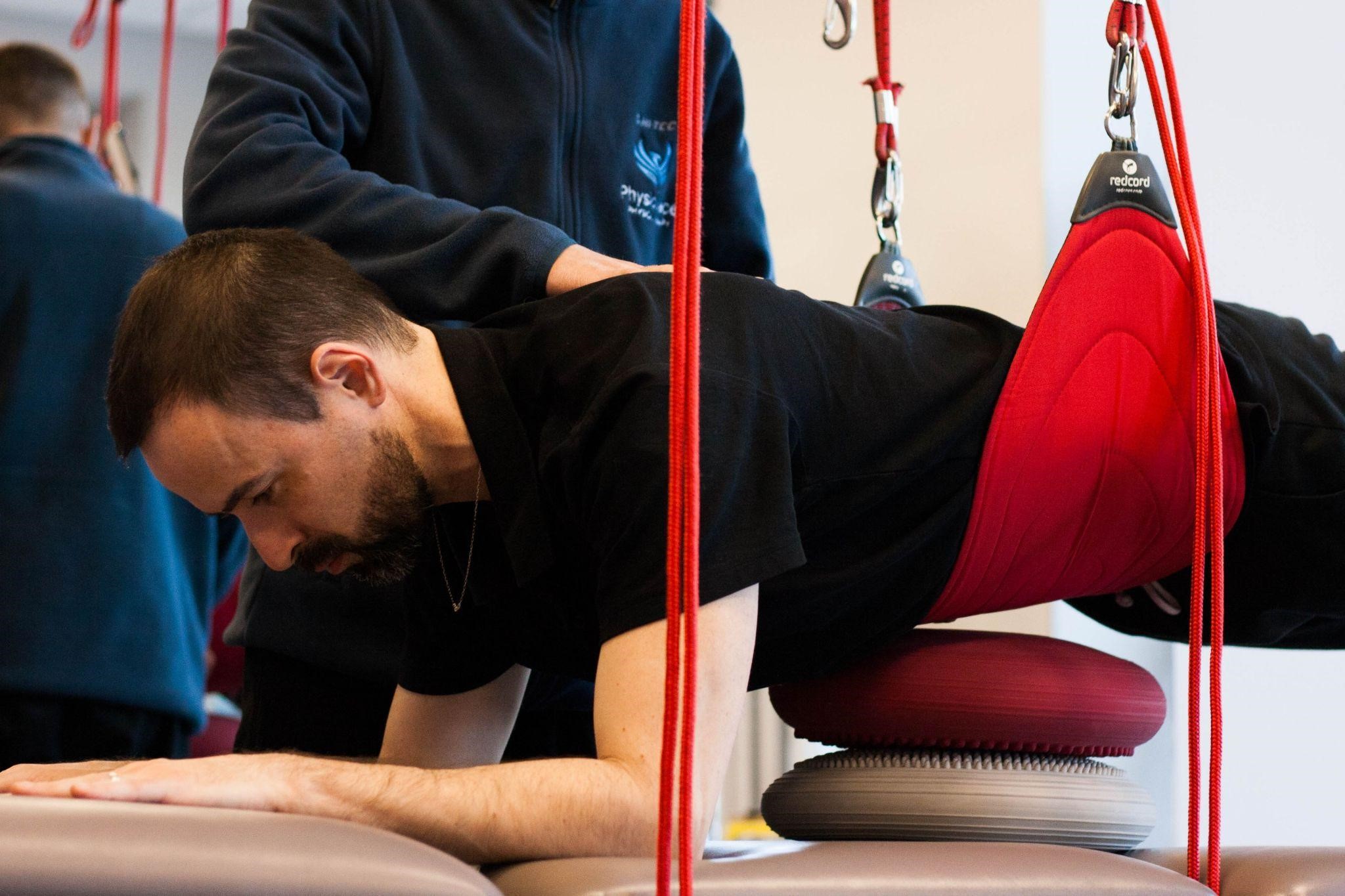
A particularly common condition is non-specific lower back pain — a situation where pain is present but there is no single clear structural cause that can be “removed” with a pill or surgery. In such cases, modern rehabilitation increasingly uses the Neurac method in combination with the Redcord system — an approach aimed at eliminating the causes of pain by restoring proper muscle function and movement control.
What does “non-specific lower back pain” mean?
This is pain in the lower back that:
- is not related to fractures, tumors, or acute infections;
- does not have one clear cause visible on MRI or X-ray;
- often occurs due to overload, weak stabilizing muscles, sedentary lifestyle, stress, or incorrect movement patterns;
- may recur in waves.
Such cases account for a significant proportion of back pain consultations.
Why do medications often provide only temporary relief?
Medications can reduce symptoms:
- reduce inflammation;
- decrease muscle spasm;
- temporarily relieve pain.
But if the cause is:
- weak deep core muscles;
- unstable pelvis;
- overloaded muscle groups;
- incorrect movement patterns;
- compensations for weak areas,
then the problem often returns after the medication wears off.
That is why active rehabilitation, not just passive pain relief, is essential.
What is Neurac?
Neurac stands for Neuromuscular Activation. It is a Norwegian rehabilitation method focused on:
- restoring proper motor control;
- activating weak muscles;
- reducing pain without symptom provocation;
- eliminating compensatory movement patterns;
- returning to normal activity.
What is Redcord?
Redcord is a professional suspension system used for Neurac therapy.
It allows:
- partial unloading of body weight;
- exercises without axial compression on the lower back;
- precise load adjustment;
- activation of deep stabilizing muscles;
- training even during pain.
How do Neurac + Redcord help with lower back pain?
1. Reduces spinal overload
When the body is supported by slings, the lower back is not exposed to excessive compression, allowing movement without symptom aggravation.
2. Activates “sleeping” muscles
Often during pain, the following become inactive:
- deep abdominal muscles;
- pelvic stabilizers;
- small spinal stabilizers;
- gluteal muscles.
Therapy helps restore their function.
3. Removes compensations
When some muscles are weak, others become overworked, causing spasm, fatigue, and pain. Neurac balances the system.
4. Re-educates movement
The body gradually relearns how to:
- bend correctly;
- lift loads without overload;
- stabilize the core;
- walk and sit without excessive tension.
Who is this method for?
People with sedentary work
Prolonged sitting often leads to weak core muscles and lower back overload.
Those with recurring pain
When massage or medication provides only short-term relief.
After physical overload
After gardening, repairs, sports, or heavy lifting.
After an acute “lumbago” episode
When acute pain has decreased but the back remains unstable.
Active individuals and athletes
For safe return to physical activity.
How does rehabilitation proceed?
Stage 1. Assessment
The specialist evaluates:
- when pain occurs;
- which movements provoke symptoms;
- which muscles are weak;
- where instability is present;
- how the body compensates.
Stage 2. Exercise selection in Redcord
Exercises are individualized — there is no single program for everyone.
Stage 3. Progression
From simple pain-free positions to more complex movements and return to normal life without fear.
Is it painful?
The main principle is painless movement.
If an exercise causes pain, the specialist adjusts:
- position angle;
- level of support;
- load;
- range of motion.
This allows even sensitive patients to train safely.
How many sessions are needed?
It depends on the condition:
Functional overload: 5–8 sessions
Chronic pain: 10–15 sessions
Long-standing recurrent issues: individualized plan
Many people notice initial improvements after just a few sessions.
Why is this better than simply “resting the back”?
Complete rest may be useful short-term in acute cases, but long-term it can worsen the condition:
- muscles weaken;
- movement decreases;
- fear of movement increases;
- spinal endurance declines.
Controlled movement under supervision is usually a more effective recovery strategy.
Common mistakes in lower back pain
- waiting for it to “go away on its own” for months;
- relying only on painkillers;
- avoiding all movement;
- training abs through pain;
- copying online exercises without assessment;
- returning to activity too early.
When should you see a doctor?
If pain is accompanied by:
- weakness in the leg;
- loss of sensation;
- bladder control issues;
- high fever;
- trauma-related onset;
- sudden worsening condition.
Conclusion
Non-specific lower back pain is often not caused by a “broken spine,” but by impaired muscle function, movement control, and tissue overload.
That is why the Neurac + Redcord method is a modern and effective approach: it helps reduce pain without medication, restore proper movement, and return to an active life.
Not just symptom relief — but addressing the cause.
Consultation booking
To understand the source of your pain, a functional assessment with a specialist is recommended. An individualized rehabilitation program is far more effective than general online advice.