



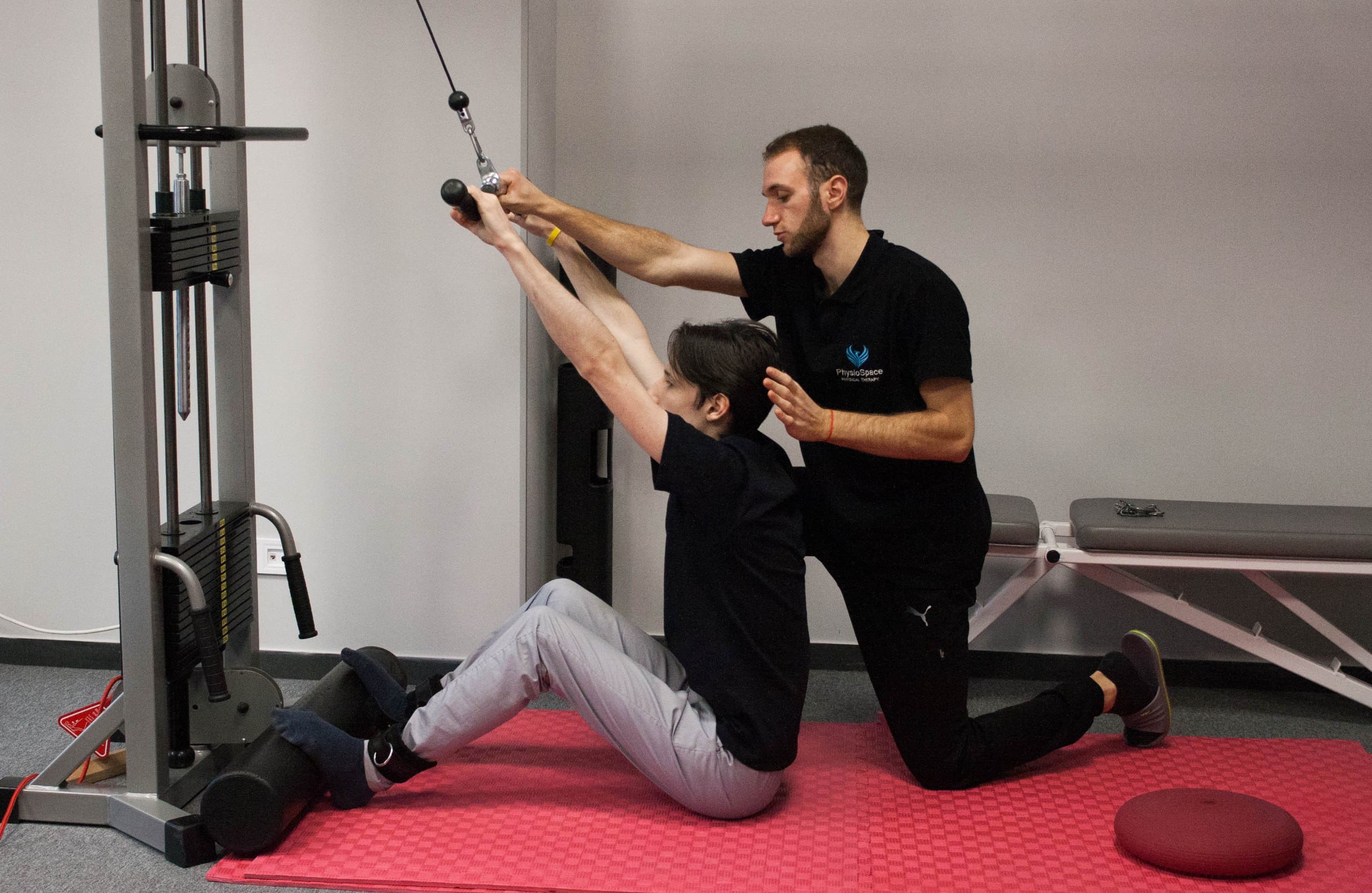
Back pain, shoulder asymmetry, or a feeling of constant fatigue in the lower back are often attributed to spinal curvature. However, there are many myths surrounding this topic: from promises to “straighten your back in 10 massage sessions” to threats of mandatory disability.
Modern physical therapy for scoliosis is based on evidence-based medicine and provides a clear understanding: what can be corrected completely, what can be partially corrected, and where the main goal is to stop progression and relieve pain. Let’s look at how rehabilitation works for children, adults, athletes, and people with high physical activity.
How scoliosis differs in children and adults: anatomical context
Scoliosis is a three-dimensional deformity of the spine that includes lateral deviation, rotation (twisting) of the vertebrae, and a change in natural curves. The approach to recovery depends fundamentally on the age and condition of the bone tissue.
X-ray picture and bone growth zone
The main factor in childhood and adolescence is the condition of the bone growth zones (assessed by the Risser test on the radiograph). While the bone skeleton is forming, the spine remains flexible and plastic. This gives a high potential for anatomical correction of the arch. In adults, bone growth is complete, so the structure of the vertebrae no longer changes under the influence of exercise alone.
Scoliotic Arch and Muscle Imbalance
In scoliosis, the muscles along the spine work unevenly: on one side of the arch they are in a constant state of overexertion, on the other – in an elongated and weakened state. With age, this imbalance leads to accelerated wear of the intervertebral discs, the appearance of protrusions and persistent pain.
What can physical therapy really change in scoliosis?
A realistic assessment of the possibilities of physical therapy helps to avoid vain expectations and focus on achievable goals.
Correction options in children and adolescents
During the period of active growth, specialized exercises and corseting can reduce the angle Cobb (degree of curvature), and in several cases – to completely stabilize the spine within the physiological norm.
Rehabilitation tasks for adults
In adulthood, physical therapy does not aim to change the shape of the skeleton on X-rays. The main tasks here are different:
- Eliminating chronic back and neck pain.
- Improving posture through muscle adaptation.
- Stopping degenerative progression of curvature.
- Restoring mobility and functionality in everyday life, sports, or during combat missions.
Expected results of physical therapy
| Age category / Group | Main goals of rehabilitation | Anatomical correction of the arch | Reduction of pain and functionality |
| Children and adolescents (until the growth zones close) | Reduction of the angle of curvature, stabilization of the spine | High (with compliance protocols) | High |
| Adults (20–50 years) | Eliminating pain, stopping progression, correcting muscle tone | Minimal / Absent (changes muscle geometry, not bones) | High |
| Elderly people | Maintaining mobility, preventing falls, controlling pain | Absent | Medium / High |
| Athletes and military | Adaptation to high loads (body armor, weight), compensation strength | None | High |
Evidence-based physical therapy methodsscoliosis
Modern rehabilitation has abandoned “general physical education”. Specific approaches are most effective.
Scoliosis-Specific Exercises (PSSE) and the Schroth Method
The Schroth Method is the gold standard for conservative treatment of scoliosis. It includes:
- Three-dimensional self-correction: the patient learns to consciously bring the spine into the correct position using special starting positions.
- Rotational breathing: a special breathing technique that directs air into the hollow (concave) areas of the chest, straightening them from the inside.
- Integration into everyday life: fixing the correct position while sitting, walking and working.
Note: According to the international recommendations of SOSORT (Scientific Society on Scoliosis Orthopaedic and Rehabilitation Treatment), PSSE techniques have the highest level of evidence among conservative approaches.
The role of corseting
In progressive scoliosis in children (angles from $20^\circ$–$25^\circ$), physical therapy is necessarily combined with wearing a rigid orthosis (Chenot corset). The physical therapist teaches the child to maintain muscle tone during and after removing the brace.
General physical activity and adaptation
After mastering basic self-correction, patients are recommended to return to an active life. Adults with sedentary jobs, athletes or military personnel who wear equipment need strength adaptation: strengthening the muscles of the core, buttocks and back under conditions of properly selected load.
What NOT to do: ineffective and dangerous methods
Unfortunately, there are still methods on the rehabilitation market that have no evidence base or can be harmful.
Myths and facts about scoliosis treatment
| Ineffective / Risky method | Why it doesn’t work or is dangerous | Evidence-based alternative |
| Manual therapy (“vertebrae” adjustment) | Vertebrae in scoliosis do not “pop out.” Forced repositioning injures ligaments and increases instability. | Active Schroth Exercises (PSSE). |
| Massage Only | Massage relaxes muscles for 1–2 hours, but does not change the movement pattern or strengthen weakened areas. | Use massage only as an adjunct before training. |
| Ban on any sport | Complete lack of load leads to muscle hypotrophy and increased pain. | Exercise modification and adaptive strength training. |
| Electrostimulation of muscles | Does not form conscious control of posture and does not affect structural changes. | Active physical therapy with the participation of patient. |
How to build a safe recovery process: steps for the patient
- Consultation and diagnostics: take a panoramic x-ray of the spine in full height (standing) and consult an orthopedic doctor or physical therapist.
- Functional assessment: the specialist determines the type of arch, muscle imbalances and the level of pain syndrome.
- Self-correction training: under the guidance of a physical therapist, you will master an individual set of exercises.
- Regularity and integration: performing exercises at home (15–30 minutes daily) and controlling posture in everyday life.
Frequently asked questions
Can I completelycure scoliosis of 2-3 degrees in adulthood?
It is impossible to completely anatomically align the bone structure in adults without surgical intervention. However, with the help of physical therapy, you can completely get rid of pain, improve the visual silhouette and restore full working capacity.
Can you play sports or wear heavy things (for example, a bulletproof vest) with scoliosis?
Yes, you can. The main condition is to teach the core muscles to properly stabilize the spine. A physical therapist selects special preparatory exercises that adapt the body to increased loads.
How long does it take to train to see results?
The first changes in pain perception and posture control appear after 4–6 weeks of regular training. To stabilize the result in children or to permanently relieve pain in adults, systematic work is required for 6–12 months.
Conclusion
Physical therapy for scoliosis is not about magically straightening the back in a few days, but about scientifically based individual work. For children, this is a real chance to stop the curvature and avoid surgery. For adults, athletes and people with high loads, it is a reliable way to live without pain, remain active and confident in your own body.