



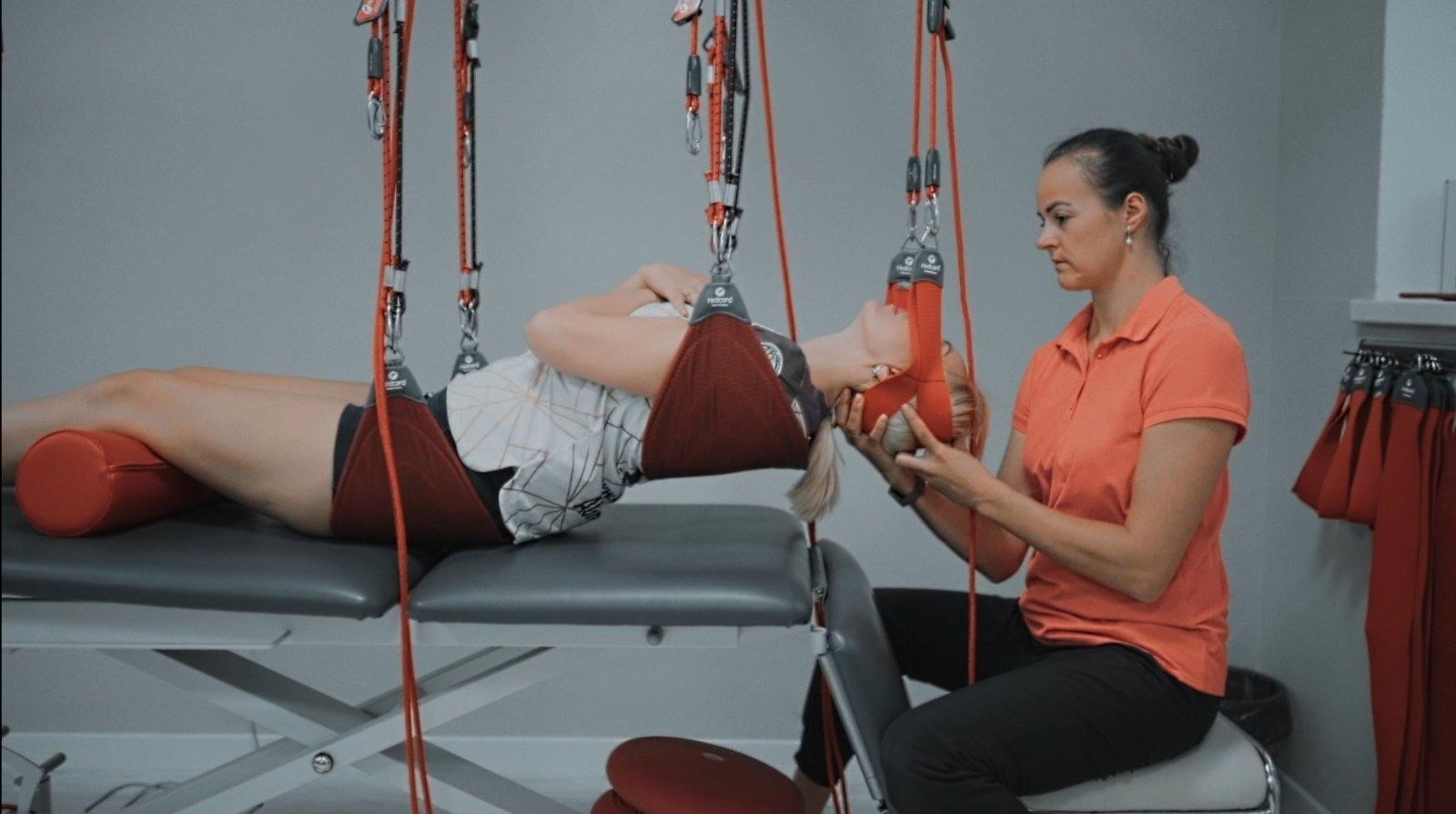
How the Redcord Suspension System Works and Why It Is Used in Modern Physical Therapy
Pain in the back, neck, shoulder, or knee is not always related only to injury or age. In many cases, the problem is caused by impaired motor control, weak stabilizing muscles, asymmetrical load distribution, and incorrect movement patterns.
Modern rehabilitation is increasingly moving away from passive treatment and toward active recovery methods. One of such solutions is Redcord — a professional suspension system designed for diagnostics, treatment, and functional training. Redcord is used in clinics, rehabilitation centers, and sports medicine facilities worldwide.
What is Redcord?
Redcord is a specialized system of ropes, slings, straps, and adjustable support points that allows exercises to be performed with partial or full unloading of body weight.
Simply put — the system helps a person move without pain, properly activate muscles, and gradually restore strength and motor control.
The equipment was developed in Norway and is widely used in rehabilitation, physical therapy, and athletic training.
What is the main idea of the system?
When a person experiences pain, the body often begins to compensate:
- some muscles become overstrained;
- others are barely activated;
- movements become asymmetrical;
- joints become overloaded;
- the problem repeats again and again.
Redcord allows you to reduce unnecessary load and “reset” proper body function.
How does Redcord work?
1. Body weight unloading
The system supports part of the body weight through slings and elastic elements. This allows:
- performing exercises without pain;
- moving even after injuries;
- working in early stages of recovery;
- reducing pressure on the spine and joints.
For many patients, this is the first opportunity to move comfortably after long-term pain.
2. Controlled instability
The slings create an unstable environment. As a result, the body is forced to activate deep stabilizing muscles.
The following are engaged:
- core muscles;
- deep back muscles;
- pelvic stabilizers;
- scapular muscles;
- small stabilizers of the knee and shoulder.
These are the muscles that are often “switched off” during pain conditions.
3. Precise load adjustment
A specialist can accurately modify:
- level of support;
- exercise difficulty;
- range of motion;
- position stability;
- load distribution on a specific side of the body.
This makes the system safe for both beginners and athletes.
Why is Redcord considered a modern approach?
Active treatment instead of passive
Instead of only temporarily relieving symptoms, the person actively participates in recovery.
Treatment of the cause of pain
Not only discomfort is reduced, but weak links and incorrect movement patterns are corrected.
Individual customization
Each exercise can be adapted to a specific patient.
Gradual progression
From simple movements to full functional load.
Where is Redcord used?
Low back pain
One of the most common applications — recovery from nonspecific low back pain, core weakness, and recurrent flare-ups.
Neck pain
Helps restore control of neck and shoulder girdle muscles and reduce tension.
Knee
After injuries, overload, instability, and postoperative recovery.
Shoulder
For impingement, scapular weakness, and shoulder joint instability.
Postoperative rehabilitation
When a controlled and safe return to movement is required.
What is the Neurac method and how is it related to Redcord?
Neurac (Neuromuscular Activation) is a clinical method often performed using the Redcord system.
Its goals:
- identify weak functional links;
- restore neuromuscular control;
- eliminate compensations;
- reduce pain;
- restore normal movement.
In other words, Redcord is the tool, and Neurac is the method used with it.
How is Redcord different from regular fitness or TRX?
Standard straps / training:
- more focused on physical fitness;
- less precise adjustment;
- not always suitable for pain conditions.
Redcord:
- designed specifically for therapy and rehabilitation;
- precise load dosing;
- can be used even with pain;
- applied in clinical practice;
- suitable for early recovery stages.
Is the system suitable for beginners?
Yes. One of Redcord’s advantages is that it can be used by people of all ages and fitness levels.
You can start with very simple exercises and gradually progress to more complex ones.
How many sessions are needed?
It depends on the situation:
Mild functional disorders: 5–8 sessions
Chronic pain: 10–15 sessions
Post-injury cases: individual plan
Many people notice initial improvements after just a few sessions.
Main benefits of Redcord
No medication
Focus on natural movement restoration.
Safety
Load is controlled by a specialist.
Deep muscle activation
Targets muscles that are difficult to engage with standard exercises.
Functional results
Improved walking, sitting, working, and training.
Prevention of recurrence
Through correction of underlying causes.
When should you seek help?
If you have:
- persistent low back pain;
- neck stiffness or tension;
- knee pain when climbing stairs;
- temporary relief from massage only;
- fear of movement due to pain;
- want recovery without medication.
Conclusion
Redcord is a modern rehabilitation system that combines biomechanics, neuromuscular activation, and a functional approach to recovery.
Its value lies in addressing not only symptoms but also the causes of pain: weakness, instability, impaired motor control, and incorrect loading patterns.
For many people, it is a path back to normal life without constant pain, limitations, and fear of movement.
Consultation booking
To understand whether Redcord rehabilitation is right for you, it is best to undergo a functional assessment with a specialist. After that, an individual recovery plan can be created to help you return to an active life.