



Long hours of desk work, suddenly lifting a child, or an awkward movement at the gym often end the same way—with sudden or persistent discomfort in the lower back. In an attempt to relieve the pain, many people apply warming gels or start doing endless sit-ups, hoping to strengthen their lower back. However, traditional crunches often make back pain even worse without addressing the underlying biomechanical problem.
The real cause of most chronic spinal overload is impaired body stabilization due to deep muscle imbalance. In this article, we’ll explain why a weak core forces your spine to work beyond its capacity and how to train your muscles to function as a single, reliable natural corset.
What are the core muscles? Debunking the “six-pack abs” myth
Many people mistakenly believe that the core consists only of the rectus abdominis—the muscle responsible for the coveted six-pack abs. In reality, from an anatomical and physical therapy perspective, the core (from the English word core) is a complex three-dimensional system surrounding the abdominal cavity. It functions like a cylinder, with the diaphragm forming the top, the pelvic floor muscles forming the bottom, the multifidus muscles supporting the back, and the transverse abdominis together with portions of the oblique muscles forming the front and sides.
The primary role of this system is not to bend the body forward but rather to keep it stable during external loads, static postures, and movement through space. The transverse abdominis acts like a natural weightlifting belt: when it contracts, intra-abdominal pressure increases, absorbing up to 40% of the vertical load that would otherwise be transferred to the intervertebral discs.
Why a weak core inevitably leads to back pain
When the deep stabilizing muscles are inactive or weak, the spine loses its biomechanical support. Every step, bend, or lift—even picking up a light shopping bag—creates tiny movements between the vertebrae. The nervous system immediately detects this instability and, in an attempt to protect the spinal cord, signals the superficial lower back muscles to tighten and stabilize the spine.
This protective muscle spasm is what many patients experience as constant, exhausting back pain. Superficial muscles are designed for short, powerful movements—not for maintaining posture all day. As they become chronically overloaded, blood flow decreases, trigger points develop, and the intervertebral discs wear out much faster, increasing the risk of disc protrusions and herniations.
Superficial muscles vs. deep stabilizers: what’s the difference?
When it comes to maintaining balance and protecting the musculoskeletal system, muscles can be divided into two major groups based on their histological structure and functional role.
| Comparison Parameter | Deep Stabilizers (Core Muscles) | Superficial Movement Muscles |
| Primary Function | Body stabilization and control of subtle spinal movements. | Generating force and producing large-amplitude movements. |
| Muscle Fiber Type | Slow-twitch (tonic) fibers—highly fatigue-resistant and capable of working for hours. | Fast-twitch (phasic) fibers—powerful but fatigue quickly. |
| Activation Pattern | Activate automatically milliseconds before any movement begins. | Activate during conscious movement execution. |
(Clinical studies in evidence-based rehabilitation have shown that patients with chronic low back pain often exhibit delayed activation—or complete failure to activate—the transverse abdominis muscle, confirming that impaired stabilization is a primary factor.)
How to test your core: 3 simple functional assessments
An experienced physical therapist always begins with functional testing. You can also assess your core endurance at home using these simple tests:
- Standard plank test. Hold your body in a straight line while supporting yourself on your forearms and toes. If your lower back sags or your abdomen drops before 60 seconds, your core likely needs strengthening.
- Side plank test. Support your body on one elbow while lying on your side. For a healthy adult, maintaining a stable position for at least 45 seconds without shaking or hip sagging is considered normal.
- Straight leg raise test (lying on your back). Place your hands under your lower back and lift one straight leg about 15 cm (6 inches) off the floor. If your lower back presses heavily into your hands or arches excessively, your deep core muscles are not effectively controlling pelvic stability.
Effective exercises to restore spinal stability
Strengthening your core muscles doesn’t require heavy dumbbells or sophisticated gym equipment. Modern physical therapy emphasizes isometric therapeutic exercises, where the primary goal is to maintain stability while resisting gravity or limb movement.
1. Dead Bug
Lie on your back with your arms extended toward the ceiling and your hips and knees bent to 90 degrees. Slowly lower the opposite arm and leg (for example, the left arm and right leg) toward the floor while keeping your lower back in contact with the surface. This exercise teaches the core to stabilize the spine while the limbs are moving.
2. Bird Dog
Start on your hands and knees with your shoulders directly above your hands and your hips above your knees. Slowly extend one arm forward and the opposite leg backward until they form a straight line with your torso. Keep your pelvis level and avoid arching your lower back.
3. Side Plank
This is an excellent exercise for activating the quadratus lumborum and oblique abdominal muscles, which play a key role in preventing sideways spinal movement. Perform the exercise either statically or dynamically by lifting your hips off the floor while keeping your neck, spine, and legs aligned.
4. If you can’t do it on your own, work with a physical therapist
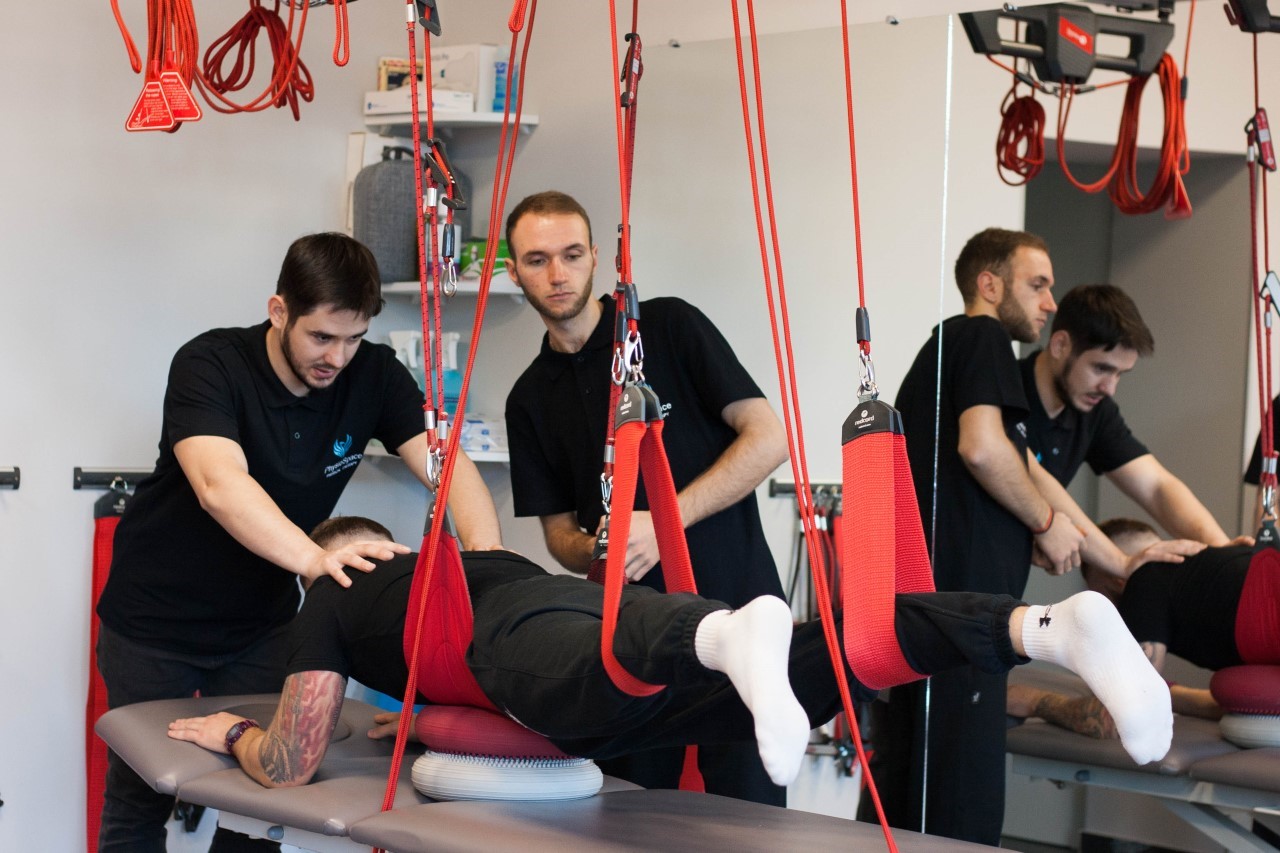
One of the most effective evidence-based methods for activating the core muscles is the Neurac method. It allows for targeted, pain-free activation of the deep stabilizing muscles. These techniques are performed using the Redcord suspension system, which partially unloads the body and allows carefully selected starting positions that enable efficient activation of the core muscles.
FAQ
If I do ab exercises every day, why does my back still hurt?
Because traditional crunches primarily train the superficial rectus abdominis while doing very little to activate the deep stabilizing muscles. In fact, repetitive spinal flexion increases pressure on the intervertebral discs and may actually worsen the problem.
Can a back brace help if I have a weak core?
A rigid back brace can be useful during the first days after major injuries or surgery. However, wearing it for prolonged periods (more than 2–3 weeks) causes the stabilizing muscles to weaken because the brace performs their function. Once the brace is removed, the pain often returns even more intensely.
How quickly can improved core stability reduce back pain?
When properly selected exercises prescribed by a physical therapist are performed consistently (3–4 times per week), the first lasting improvements in pain reduction and posture typically become noticeable within 4–6 weeks.