



New concepts in physical therapy of the 20th–21st centuries
Modern physical therapy is based on scientific research and integrates new concepts that help to understand the body better. Some of the key ideas of recent decades have significantly influenced rehabilitation methods – from attention to deep stabilizer muscles to a rethinking of human anatomy as a single system.
The role of the core muscles in body stabilization
Traditionally, physical therapy has emphasized strengthening the limbs or developing general endurance, but modern research has emphasized the importance of the core muscles – a complex of deep muscles in the center of the body (Fig. 1):
– abdominals
– diaphragm,
– back muscles
– pelvic floor
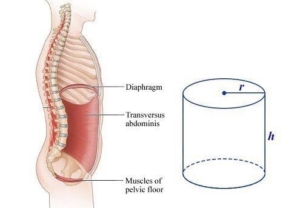 Fig. 1
These muscles provide stability to the spine and pelvis, creating a kind of “corset” to protect the spine during movement. The concept of core training gained popularity in the 1990s under the influence of clinical studies of low back pain and Pilates techniques. Today, strengthening the stabilizer muscles is a standard part of rehabilitation for spinal injuries, posture disorders, after childbirth, etc.
Scientific evidence supports the effectiveness of core stabilization exercises. According to a 2022 systematic review, core muscle training programs led to significant pain reduction, improved function, and increased trunk muscle strength in patients with chronic non-specific low back pain ( A Systematic Review of the Effectiveness of Core Stability Exercises in Patients with Non-Specific Low Back Pain – PMC ) ( A Systematic Review of the Effectiveness of Core Stability Exercises in Patients with Non-Specific Low Back Pain – PMC ). Based on a body of research, experts concluded:
Core stability exercises can be considered an effective treatment for non-specific low back pain ( A Systematic Review of the Effectiveness of Core Stability Exercises in Patients with Non-Specific Low Back Pain – PMC ).
In other words, strengthening the deep stabilizer muscles improves spinal support and can prevent pain recurrence. Today, this concept is implemented in physical therapy protocols for back pain, rehabilitation after spinal injuries, fall prevention in the elderly, etc.
The concept of “anatomical trains” by Thomas Myers
Another revolutionary idea was the idea of the human body as a single myofascial network. In 2001, American researcher Thomas Myers published the work Anatomy Trains, in which he described continuous lines of communication between muscles through fascia – connective tissue membranes. According to this concept, individual muscles do not work in isolation: they are combined into long chains (meridians) that run along the body (for example, the superficial posterior chain from the feet to the skull, spiral and other lines). This approach helps to explain why, for example, muscle tension in the lower back can affect the condition of the neck, and vice versa.
Myers’ concept quickly spread among specialists in manual therapy and kinesiology.
“The Anatomy Trains myofascial meridian map appeared in 2001 and quickly became widely used in the world of body-oriented techniques. By connecting muscles through fascial tissue, it allows you to understand the anatomy of posture and functional movement more holistically, in contrast to the disjointed study of individual muscles” (Anerkannt von Thomas W. Myers) (Fig. 2).
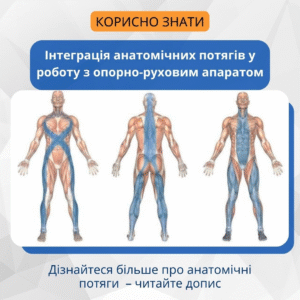 Fig. 2
In other words, the “anatomical trains” have given physical therapists a tool for a more holistic analysis of movements: attention is paid to the interaction of muscle groups and the balance of tension throughout the body. In practice, this is expressed in the use of myofascial massage, fascial stretching, kinesiotaping along meridian lines, and in the fact that when developing a rehabilitation program, the therapist takes into account distant relationships:
for example, working with the musculo-fascial chain can improve posture and movement even in areas where there is no obvious injury).
Changing approaches to restoring functionality
In recent decades, there has been a shift from a purely biomedical approach (treating a single organ or symptom) to a biopsychosocial and functional model of rehabilitation.
● Modern physical therapy considers the patient comprehensively, focusing on restoring his ability to perform everyday tasks and participate in an active life, and not only on eliminating a physical defect.
This philosophy is reflected in the International Classification of Functioning (ICF). According to the ICF, the success of rehabilitation is assessed not only by medical indicators, but also by the level of activity and participation of a person in social life.
This approach means that instead of isolated training of a muscle or joint, the therapist sets the goal of restoring a specific function:
● for example, learning to walk independently
● climbing stairs
● returning to work or a favorite hobby
In practice, this is implemented through functional training – exercises that simulate real movements: squatting, as an analogue of getting up from a chair, balance training – as preparation for walking on uneven terrain, etc. (photo 1).
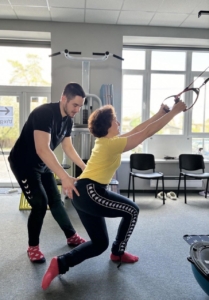 photo 1
In addition, great attention is paid to patient education: they are actively involved in the process, the purpose of each exercise is explained, and self-control and self-healing skills are developed. This evolution of views is supported by studies that demonstrate that active therapy is more effective than passive therapy.
In particular, in chronic pain syndromes, active therapeutic interventions (exercises, training) give better long-term results than passive methods (massage, electrotherapy, etc.) ( The effect of neurac training in patients with chronic neck pain – PMC ). That is why the motto of modern rehabilitation can be considered: “Movement is medicine”.
An important component of the new approach is also the consideration of psychological and social factors. Physical therapists work in a team with doctors, occupational therapists, psychologists to overcome not only physical limitations, but also fear of movement, loss of motivation, and barriers in the environment.
photo 2
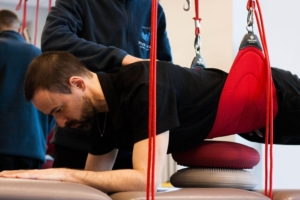
In conclusion, the goal of physical therapy today is not simply to restore the anatomical structure, but to return a person to the fullest possible life (photo 2).
This principle is supported by international organizations: for example, the World Health Organization emphasizes that rehabilitation (including physical therapy) is a necessary condition for ensuring health and well-being for people of all ages (Rehabilitation | World Physiotherapy).
If you need help to quickly and efficiently return to an active motor life, contact the specialists of our functional rehabilitation center PhysioSpace in Irpin at V. Stus, 27., tel. 0937001040.
Next article: WHAT ARE THE MODERN METHODS OF PHYSICAL THERAPY? WHAT IS KINESITHERAPY?