



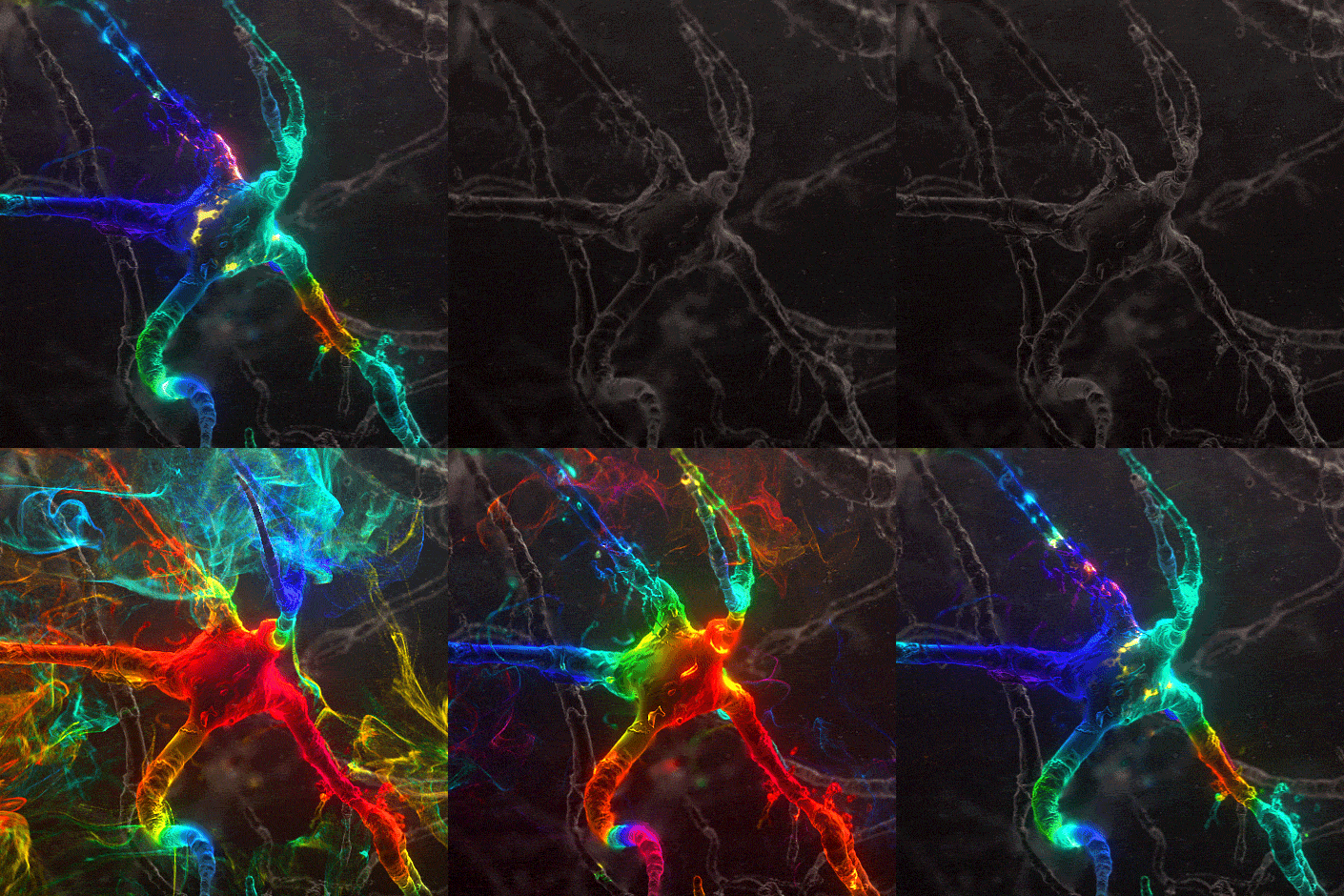
What drives us to seek help from physical therapists when most medical institutions simply shrug their shoulders?
Yes, it’s pain.
But what do we, ordinary people, really know about pain?
We can say it’s a subjective and unpleasant feeling that arises for various negative reasons, interfering with movement, life, and joy.
Would you like to understand what lies behind all this in more detail and from a scientific perspective? And more importantly, how to take control of and get rid of this traumatic phenomenon known as Chronic Pain Syndrome (CPS)? Let’s read on:
Pain: Where it comes from and how it works, its biological significance
Pain is a complex, multi-stage physiological phenomenon whose primary function is to protect living organisms. Evolutionarily, it emerged as a beneficial adaptation prompting the body to avoid harmful factors.
Life without pain is hard to imagine: we wouldn’t pull our hands away from fire or notice injuries—this would threaten our survival.
In short, pain serves as an early warning of danger: the pain signal triggers reflexes and complex responses that protect the body from further damage.
It arises when specialized nerve endings—nociceptors—are activated. These respond to potentially dangerous stimuli such as:strong pressure
high temperature
chemical irritation
and generate warning signals.
Pain reaches the brain not only as sensory information but also as an emotional experience—pain is always unpleasant and associated with suffering. This happens because pain impulses are processed in several areas of the brain, including the cortex, which forms the emotional component of pain.
Thus, pain is a phenomenon at the intersection of body and psyche—a physical and emotional experience at the same time.
Pain perception is a multi-step process:
Activation of nociceptors at the site of injury
Formation of an “inflammatory chemical mix”—a cocktail of biochemical pain mediators:
Prostaglandins – intensify pain by increasing nerve ending sensitivity. Many painkillers (like ibuprofen) block prostaglandin synthesis.
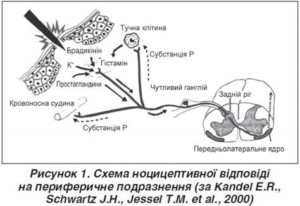
Histamine – released by immune cells during inflammation; increases blood flow and swelling, supporting pain persistence.
Bradykinin – a protein that directly causes pain and inflammation by acting on receptors.
Substance P – released by pain nerve fibers, prolonging the pain signal.
Glutamate – the main excitatory neurotransmitter, crucial in pain signal transmission in the spinal cord.
Pain impulses travel via nerve fibers to the spinal cord. Two types of fibers conduct this signal: “fast” and “slow”—hence the sharp initial pain followed by prolonged burning or aching. Then, the impulse is transmitted to the brain, where the emotional component is formed.
Interestingly, our body has a natural pain relief system. It can suppress pain signals at the spinal cord level through the release of endorphins and enkephalins—morphine-like substances produced by the body. The brain sends a command to dampen pain when it no longer serves a protective function.
Chronic Pain Syndrome: When pain becomes a disease
A condition where pain persists for over 3 months and no longer serves a protective role.
Today, chronic pain is seen not just as a symptom, but as a standalone pathological condition involving nervous system remodeling.
Pain “takes on a life of its own,” regardless of the original damage.
Main types of chronic pain:
Inflammatory chronic pain – due to ongoing pathology (e.g., rheumatoid arthritis)
Neuropathic pain – from nerve damage (e.g., diabetic neuropathy, nerve trauma)
Nociplastic pain – without peripheral injury; the issue lies in nervous system dysregulation (e.g., fibromyalgia, IBS)
The nervous system learns to generate pain even without signals from receptors.
Effects of chronic pain on the brain and psyche:
Persistent pain physically drains and alters a person’s mental state.
Neuroplasticity—our brain’s ability to reorganize—plays a dual role. It contributes to “pain memory” and also changes the brain areas responsible for emotions, thinking, and behavior.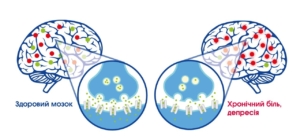
Emotional state deteriorates—chronic pain leads to anxiety, depression, and irritability.
It shares common neurobiological mechanisms with depression: both show reduced neurotransmitter levels (serotonin, dopamine, norepinephrine, acetylcholine).
Chronic pain and depression activate similar brain regions. A person sees the world through a dark lens, loses interest, struggles with sleep and motivation.
A vicious cycle forms: fear of pain enhances pain perception, and pain reinforces fear. Cognitive impairments also arise: poor concentration, memory issues, mental fatigue.
The brain shifts focus from the outside world to inner suffering.
Non-drug pain treatment – movement therapy and endorphins:

Physical and manual therapy doesn’t always aim to eliminate the root cause but modulates pain pathways and improves life quality.
Mechanisms:
Physical activity releases endorphins—our internal painkillers, which reduce pain.
Exercise activates descending nociceptive pathways in the brain, which send inhibitory signals to spinal pain neurons using serotonin and norepinephrine.
Regular exercise raises pain threshold by stimulating internal analgesic systems.
Manual therapy and massage:
Manual therapy involves gentle techniques (mobilization, post-isometric relaxation) and firmer manipulations of joints and spine to reduce muscle spasms and restore mobility.

It interrupts the “pain-spasm-pain” cycle by relaxing muscles and improving blood flow.
It also modulates the nervous system’s response to pain (neuromodulation).
Massage also promotes release of oxytocin and endocannabinoids, which provide comfort and reduce pain. Even simple stroking of a sore spot instinctively helps—activating natural pain relief mechanisms.
Conclusion:
Pain is an evolutionary alarm signal, essential for survival. When regulation fails, it becomes chronic and exhausting.
Understanding pain neurophysiology—from nociceptors to emotions—helps medicine develop new treatment strategies.
Combining pharmaceuticals with physical movement, manual therapy, and psychotherapy helps reprogram the nervous system and restore quality of life.
Sources: